WELCOME TO REACON

- All
- Product Name
- Product Keyword
- Product Model
- Product Summary
- Product Description
- Multi Field Search
 |
REACON
| Quantity: | |
|---|---|
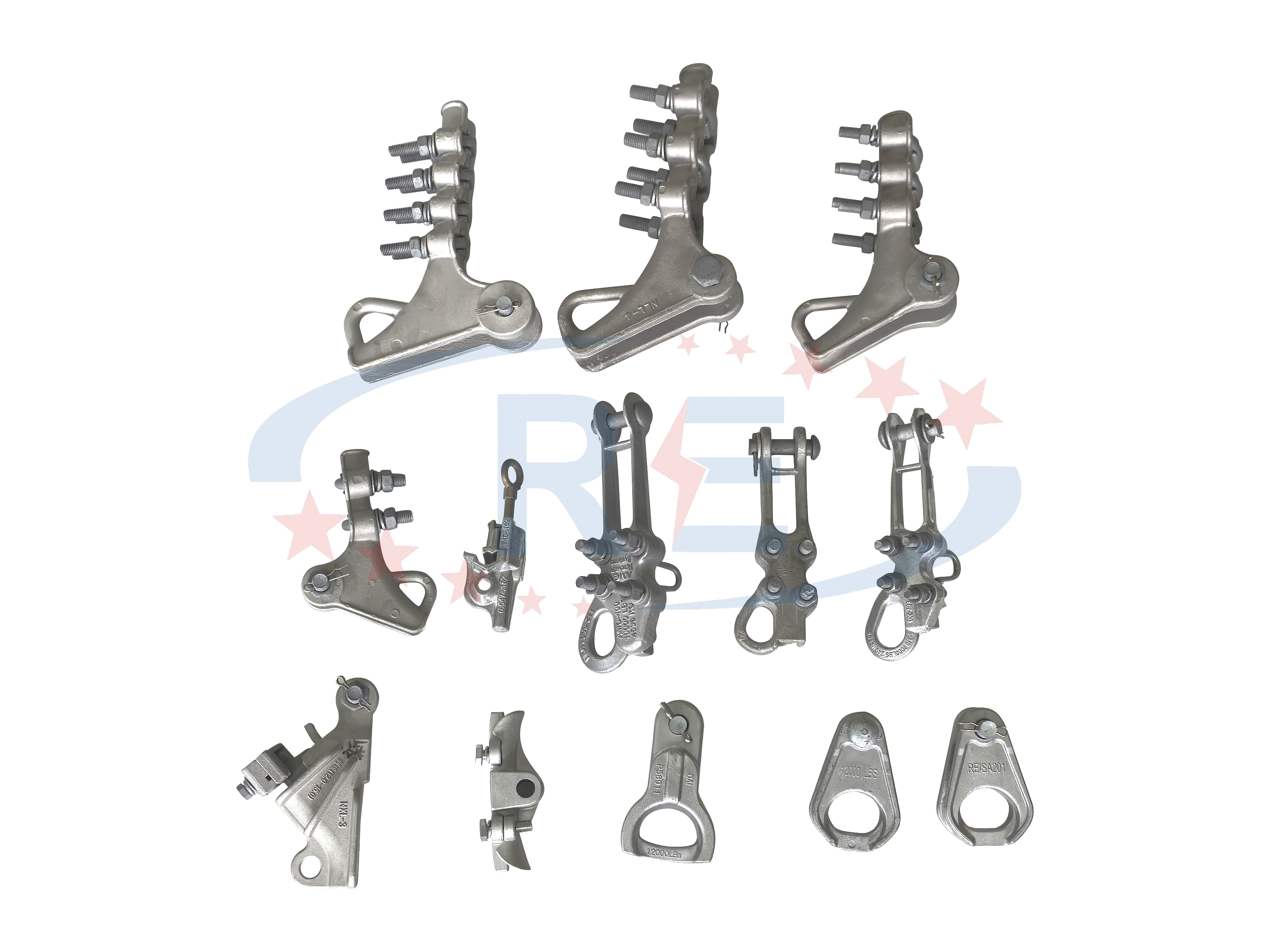
The REACON Aluminum Alloy Strain Clamp is a mechanical tension fitting developed for anchoring overhead conductors at designated points along power transmission and distribution networks. It provides a firm gripping arrangement that holds the conductor in position while transferring mechanical tension to the supporting insulator assembly or pole structure.
Unlike suspension fittings, which mainly carry the vertical weight of conductors, strain clamps are installed at locations where the line direction changes, a conductor section terminates, or mechanical tension must be maintained between adjacent spans.
The clamp assembly features an aluminum alloy body combined with galvanized steel fastening components. This material arrangement balances structural strength with relatively low component weight, making it suitable for outdoor overhead line installations.
Depending on the selected configuration, the assembly can include a clamp body, keeper, U-bolts, nuts, washers, and connecting fittings. These components work together to secure the conductor and provide a mechanical connection with the corresponding line hardware.
REACON supplies aluminum alloy strain clamps for utility construction, distribution network development, and overhead transmission line projects. Different structural arrangements can be selected according to conductor dimensions, installation requirements, and mechanical loading conditions.
Item | Description |
Product Name | Aluminum Alloy Strain Clamp |
Product Type | Bolted Strain Tension Fitting |
Main Body Material | Aluminum Alloy |
Fastening Hardware | Hot Dip Galvanized Steel |
Optional Components | Stainless Steel Cotter Pins |
Connection Type | Mechanical Bolted Connection |
Application | Overhead Conductor Anchoring |
Installation Position | Dead-End and Tension Sections |
Applicable Conductors | Compatible Aluminum and ACSR Conductors |
Surface Treatment | Hot Dip Galvanizing for Steel Components |
Installation Environment | Outdoor |
Manufacturing Service | OEM and Customized Production |
The main clamp body is manufactured from aluminum alloy to provide a rigid conductor-gripping structure without adding unnecessary weight to the overhead line assembly.
Aluminum alloy is widely used in power line fittings because of its favorable strength-to-weight characteristics and compatibility with aluminum-based conductors.
The internal gripping surface is designed to accommodate the corresponding conductor profile. Correct matching between the clamp groove and conductor diameter is important for maintaining stable contact pressure.
The keeper works together with the main clamp body to hold the conductor within the designated gripping area.
During assembly, the conductor is positioned between the mating surfaces before the fastening hardware is tightened. This creates a controlled mechanical clamping arrangement that helps resist conductor movement under the specified service load.
The geometry of the gripping section is an important factor in distributing the applied pressure and reducing the possibility of localized conductor damage.
Bolts, U-bolts, nuts, and other steel fastening components are commonly protected through hot dip galvanizing.
The zinc coating forms a protective layer on the steel surface, helping reduce corrosion caused by rainwater, humidity, and outdoor atmospheric exposure.
This treatment is particularly important because fastening components remain exposed throughout the operating life of the overhead line.
A strain clamp is designed to retain the conductor at a tension point and transfer the applied mechanical force through its connecting hardware.
When installed at a dead-end structure, the clamp becomes part of the load-bearing arrangement between the conductor and the supporting pole or tower.
Its mechanical performance depends on the clamp configuration, conductor compatibility, fastening arrangement, and specified rated mechanical load.
The strain clamp can be assembled with suitable insulator fittings and connecting accessories to form a complete tension string.
Depending on the line design, associated hardware may include clevises, socket eyes, shackles, and other pole line fittings.
Proper matching of connection dimensions is essential for achieving the required assembly fit and mechanical performance.
Product Feature | Functional Advantage |
Aluminum Alloy Construction | Provides a favorable strength-to-weight ratio |
Bolted Gripping Design | Allows mechanical conductor fastening |
Separate Keeper Structure | Helps retain the conductor within the clamp |
Galvanized Steel Hardware | Improves corrosion protection of steel components |
Multiple Structural Configurations | Supports different overhead line arrangements |
Mechanical Load Transfer | Connects conductor tension to supporting structures |
Outdoor Application Design | Suitable for utility line installations |
Custom Manufacturing | Allows adaptation to project-specific drawings |
At the end of a transmission line section, conductors must be anchored to the supporting tower through suitable tension fittings.
The aluminum alloy strain clamp provides the conductor gripping component within the mechanical termination assembly. It works together with insulator strings and connecting hardware to maintain the required conductor position.
Distribution networks contain multiple tension sections separated by supporting structures.
Strain clamps are installed at designated tension points to secure the conductors and maintain the mechanical arrangement of the line. They are suitable for utility distribution projects involving compatible bare aluminum or aluminum-based conductors.
When an overhead conductor changes direction, the supporting structure may experience additional mechanical forces.
A properly selected strain clamp helps anchor the conductor at these locations and transfers the corresponding load to the pole or tower hardware assembly.
Long-span installations require careful selection of conductor support and tension fittings because of the mechanical forces associated with span length, conductor weight, and environmental loading.
The strain clamp forms part of the conductor anchoring system used in these applications.
During distribution network upgrades, new line construction, or replacement of existing conductors, compatible strain fittings are required to establish mechanical connections between conductors and supporting structures.
The aluminum alloy design provides a practical option for these overhead line projects.
Correct installation is important for maintaining conductor grip and mechanical stability. The general installation procedure is as follows:
Step 1: Select the Correct Clamp Configuration
Check the conductor type, outside diameter, required mechanical load, and connecting hardware dimensions. Select a clamp model that matches the engineering requirements.
Step 2: Inspect the Components
Check the aluminum alloy body, keeper, bolts, nuts, washers, and connecting accessories. Make sure the components are clean and free from visible damage.
Step 3: Position the Conductor
Place the conductor into the designated gripping groove of the clamp body. Ensure that the conductor sits correctly within the contact area without twisting or unnecessary displacement.
Step 4: Install the Keeper and Fastening Hardware
Position the keeper over the conductor and install the U-bolts or corresponding fastening components. Check that the hardware is correctly aligned before tightening.
Step 5: Tighten the Fasteners
Tighten the nuts evenly according to the specified installation torque. Uneven tightening may result in an irregular gripping force.
Step 6: Complete the Line Connection
Connect the strain clamp to the corresponding insulator string or pole line hardware using the specified connecting fittings.
Step 7: Final Inspection
Inspect the assembled connection for proper positioning, fastening security, and visible conductor deformation. Verify the installation according to the project’s mechanical and electrical requirements.
REACON ELECTRIC GROUP CO., LTD. supplies pole line hardware and conductor connection fittings for overhead power infrastructure.
For aluminum alloy strain clamps, manufacturing quality is closely related to the alloy material, casting or forming process, dimensional consistency, fastening hardware, and surface treatment.
The product inspection process focuses on several important areas:
Inspection Item | Quality Control Focus |
Raw Material | Aluminum alloy and steel component condition |
Clamp Body | Appearance, structural integrity, and dimensions |
Keeper | Matching fit with the main clamp body |
Fastening Hardware | Thread condition and assembly compatibility |
Galvanized Surface | Coating appearance and coverage |
Final Assembly | Component alignment and fastening condition |
Product Packaging | Protection against damage during transportation |
These inspection measures help maintain consistent product specifications and provide customers with dependable hardware for overhead line construction.
Q1: What is the main purpose of an aluminum alloy strain clamp?
A: It is used to anchor overhead conductors at dead-end positions and designated tension sections. The clamp holds the conductor mechanically and transfers the applied load to the supporting line hardware.
Q2: What is the difference between a strain clamp and a suspension clamp?
A: A suspension clamp mainly supports the conductor at intermediate points along the line, while a strain clamp is designed to secure the conductor where mechanical tension must be retained, such as at dead ends and angle structures.
Q3: Can aluminum alloy strain clamps be used with ACSR conductors?
A: Yes. Compatible designs are available for aluminum conductor steel reinforced cables. The selected clamp must match the conductor’s outside diameter and the required mechanical performance.
Q4: Why are galvanized steel bolts used with aluminum alloy clamp bodies?
A: Hot dip galvanizing provides a protective zinc coating on steel fastening components. It helps reduce corrosion during outdoor service, while the aluminum alloy body provides the main conductor-gripping structure.
Q5: How do I choose the correct strain clamp size?
A: Selection should be based on conductor outside diameter, conductor construction, rated mechanical load, bolt arrangement, and connection dimensions. The manufacturer’s technical drawing should be used for final model selection.
Q6: Can the strain clamp be installed on transmission towers?
A: Yes. Suitable configurations can be incorporated into transmission tower dead-end assemblies and other tension structures when the mechanical rating and connecting dimensions meet the project requirements.
Q7: Does REACON offer customized aluminum alloy strain clamps?
A: Yes. REACON can supply customized overhead line fittings according to customer drawings, conductor specifications, structural requirements, and project application conditions.
REACON ELECTRIC GROUP CO., LTD. specializes in power transmission and distribution equipment, including pole line hardware, conductor fittings, electrical connectors, insulators, and protection devices.
Our overhead line hardware range includes strain clamps, suspension clamps, dead-end fittings, crossarm accessories, galvanized steel fittings, and other mechanical connection components.
We support utility contractors, electrical equipment distributors, and power engineering companies with product supply and customized manufacturing services.
REACON is committed to providing practical hardware solutions for overhead power transmission and distribution infrastructure.