WELCOME TO REACON

- All
- Product Name
- Product Keyword
- Product Model
- Product Summary
- Product Description
- Multi Field Search
 |
REACON
| Quantity: | |
|---|---|
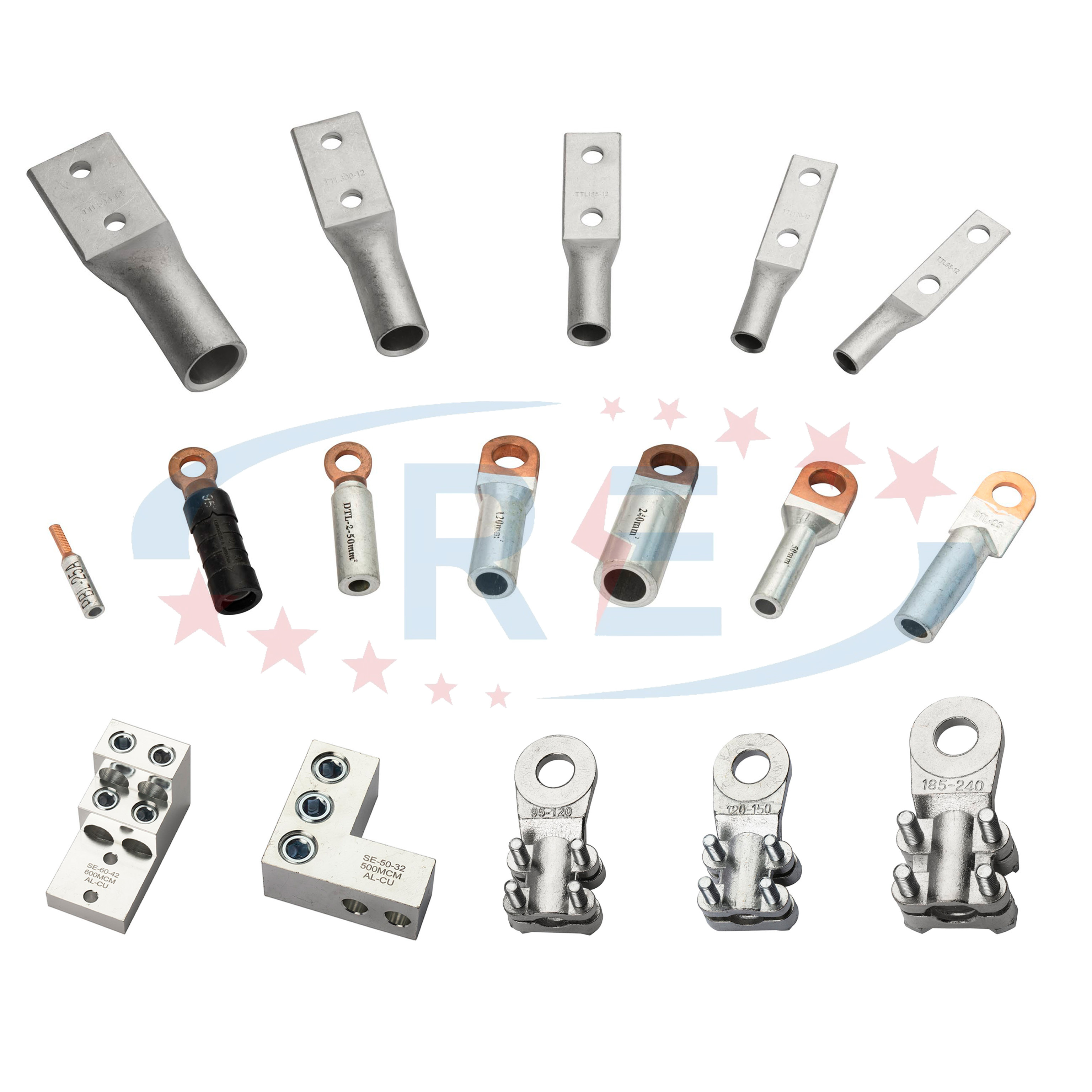
REACON DL Aluminum Cable Lug is an electrical termination component designed to connect aluminum power cables with electrical equipment, distribution assemblies, and power system components.
Manufactured from conductive aluminum and installed through compression crimping, this terminal provides a practical connection interface for aluminum conductors used in power transmission and distribution applications.
Unlike bimetallic terminals designed to connect copper and aluminum components, the standard DL aluminum cable lug is primarily intended for aluminum conductor termination. Its lightweight construction makes it suitable for various electrical installations where conductor weight, connection dimensions, and installation efficiency are important considerations.
REACON offers different aluminum terminal configurations for transformer connections, switchgear installations, overhead distribution networks, industrial wiring, and general power cable termination.
The product range covers different conductor sizes and terminal configurations, with customized manufacturing available according to customer drawings and project requirements.
Different electrical installations require different terminal configurations. REACON provides several aluminum cable lug designs to accommodate equipment connections, overhead conductor termination, and general power cable installations.
Transformers and switchgear assemblies require properly matched terminal components to connect incoming and outgoing power cables with equipment terminals.
The DL aluminum cable lug for transformer applications is designed to terminate aluminum conductors and establish a bolted connection with compatible electrical equipment.
Its main function is to provide a stable interface between the cable conductor and the equipment connection point.
Typical applications include:
• Distribution transformer cable connections.
• Medium-voltage switchgear assemblies.
• Electrical distribution cabinets.
• Substation equipment connections.
• Industrial power control systems.
This configuration is particularly suitable for equipment installations where the terminal dimensions, palm-hole arrangement, and cable entry size must match the electrical equipment.
Overhead power distribution networks commonly use aluminum conductors because of their favorable weight and electrical conductivity characteristics.
The DL Type Aluminum Lug provides a termination solution for compatible aluminum conductors connected to distribution equipment and pole-mounted electrical devices.
Compared with terminal configurations primarily used inside control cabinets, this application focuses on utility distribution infrastructure and outdoor equipment connections.
Typical applications include:
• Overhead distribution cable termination.
• Pole-mounted transformer connections.
• Outdoor electrical equipment.
• Utility distribution network construction.
• Rural electrification projects.
• Power line maintenance and upgrading.
For outdoor installations, the terminal material, surface condition, connection hardware, and environmental protection should be selected according to the actual operating conditions.
The general DL Aluminum Terminal Lug is intended for aluminum conductor termination in different electrical assemblies.
It provides a connection point between an aluminum cable and equipment terminals, making it suitable for distribution panels, transformers, industrial electrical systems, and utility installations.
Its application is not limited to a particular equipment category. The appropriate configuration can be selected according to conductor dimensions, terminal hole requirements, and installation space.
Typical applications include:
• Electrical distribution panels.
• Industrial power connections.
• Transformer terminal connections.
• Switchgear installations.
• Utility electrical infrastructure.
• Renewable energy distribution systems.
The durable aluminum crimp terminal series focuses on secure conductor termination and stable electrical contact.
Its compression-based connection structure is designed to provide a firm interface between the aluminum conductor and the terminal body when installed with compatible crimping equipment.
The compact terminal configuration is suitable for electrical assemblies where installation space and connection arrangement need to be considered.
Main characteristics include:
• Aluminum conductive construction.
• Compression-based cable termination.
• Compact terminal structure.
• Compatibility with different cable sizes according to model.
• Practical installation using suitable crimping tools.
• Stable mechanical retention after correct crimping.
Typical applications include electrical panels, switchgear, transformer stations, industrial machinery wiring, and solar power installations.
The secure-fit aluminum crimp terminal series is designed for power cable applications requiring consistent conductor positioning and reliable mechanical retention.
Its main advantage is the focus on the fit between the conductor and terminal barrel during the compression process.
When the correct terminal size, crimping die, and installation procedure are used, the connection can provide stable electrical contact and resistance to conductor movement.
Typical applications include:
• Power distribution cable termination.
• Electrical control cabinets.
• Industrial machinery connections.
• Distribution board wiring.
• Utility electrical installations.
• Field cable installation and maintenance.
The selected terminal dimensions must correspond to the actual conductor specifications to achieve the intended connection performance.
In addition to standard aluminum cable lugs, REACON provides CU-AL bimetallic terminals for applications involving copper-to-aluminum electrical connections.
Unlike a standard DL aluminum cable lug, a CU-AL bimetal terminal combines two different conductive materials within one component.
The typical construction consists of:
• Copper palm: Provides the equipment connection surface for compatible copper-side connections.
• Aluminum barrel: Accommodates the aluminum conductor.
• Bimetal transition interface: Provides the transition between copper and aluminum sections.
This structure is designed to address the material compatibility challenges associated with direct copper-to-aluminum connections.
Copper-Aluminum Transition
The bimetal structure allows copper conductors to be connected to compatible aluminum busbars or equipment interfaces.
Reduced Galvanic Corrosion Risk
A properly manufactured bimetal transition helps reduce corrosion problems associated with unsuitable direct copper-aluminum contact.
Stable Electrical Connection
The integrated copper and aluminum sections provide a suitable conductive path when correctly selected and installed.
Multiple Conductor Sizes
Different specifications can be selected according to conductor cross-sectional area and equipment connection requirements.
• Copper cable to aluminum busbar connections.
• Substation electrical equipment.
• Transformer terminal connections.
• Switchgear assemblies.
• Industrial power distribution systems.
• Solar and wind power installations.
The CU-AL terminal should be selected when the connected materials require a copper-to-aluminum transition. It should not be confused with a standard single-material aluminum cable lug.
| Comparison Item | DL Aluminum Cable Lug | CU-AL Bimetal Cable Lug |
| Product Structure | Single-material aluminum construction | Copper palm and aluminum barrel |
| Main Material | Aluminum | Copper and aluminum |
| Main Function | Aluminum conductor termination | Copper-to-aluminum transition |
| Conductor Compatibility | Primarily aluminum conductors | Compatible copper and aluminum connection interfaces |
| Connection Method | Compression crimping | Compression crimping |
| Main Advantage | Lightweight construction and aluminum cable termination | Material transition and reduced galvanic corrosion risk |
| Typical Applications | Aluminum power cables, distribution equipment, overhead networks | Copper cables connected to aluminum busbars or equipment |
The two product types serve different connection requirements. Correct material selection is essential for electrical safety and long-term connection performance.
The DL Aluminum Cable Lug series is available in different conductor sizes and terminal dimensions.
The following dimensional information is based on the existing published product specification. Customers should confirm the applicable model, material, and drawing before ordering.
Item No | Cable spec(mm2) | Dimensions(mm) | |||||
ø | D | d | L | L1 | B | ||
DTL10 | 10 | 8.5 | 10 | 6 | 68 | 28 | 16 |
DTL16 | 16 | 8.5 | 11 | 6 | 70 | 32 | 16 |
DTL25 | 25 | 8.5 | 12 | 7 | 75 | 34 | 18 |
DTL35 | 35 | 10.5 | 14 | 8.5 | 85 | 40 | 20.5 |
DTL50 | 50 | 10.5 | 16 | 9.8 | 90 | 42 | 23 |
DTL70 | 70 | 12.5 | 18 | 11.5 | 100 | 47 | 26 |
DTL95 | 95 | 12.5 | 21 | 13.5 | 110 | 50 | 28 |
DTL120 | 120 | 14.5 | 23 | 15 | 120 | 53 | 30 |
DTL150 | 150 | 14.5 | 25 | 16.5 | 125 | 55 | 34 |
DTL185 | 185 | 17 | 28 | 18.5 | 136 | 58 | 37 |
DTL240 | 240 | 17 | 30 | 21 | 148 | 60 | 40 |
DTL300 | 300 | 21 | 34 | 23.5 | 165 | 65 | 50 |
DTL400 | 400 | 21 | 38 | 27 | 170 | 70 | 50 |
DTL500 | 500D | 21 | 47 | 29 | 225 | 75 | 60 |
| Item | Description |
| Product Series | DL Aluminum Cable Lug |
| Main Material | Aluminum |
| Connection Method | Compression Crimping |
| Main Function | Aluminum Cable Termination |
| Equipment Compatibility | Transformers, Switchgear, Distribution Equipment |
| Installation Environment | Indoor and Outdoor, Subject to Product Specification |
| Customization | Available According to Drawings and Requirements |
Selecting a suitable cable lug requires more than matching the cable cross-sectional area. The conductor material, equipment connection dimensions, installation method, and operating environment should also be considered.
Step 1: Confirm the Conductor Material
Identify whether the cable uses aluminum or copper conductors.
For aluminum conductors connected to compatible aluminum equipment interfaces, a standard DL aluminum cable lug may be suitable.
For copper-to-aluminum transitions, consider a CU-AL bimetal cable lug.
Step 2: Confirm Cable Cross-Section
Check the cable cross-sectional area in mm² and compare it with the available terminal specifications.
The terminal barrel must match the conductor dimensions.
Step 3: Check Equipment Connection Dimensions
Confirm the palm width, bolt-hole diameter, hole spacing, and overall terminal dimensions according to the equipment drawing.
Step 4: Determine the Installation Environment
Consider whether the terminal will be installed in a transformer cabinet, switchgear assembly, outdoor distribution network, or industrial electrical facility.
Step 5: Confirm Crimping Requirements
Select compatible hydraulic or mechanical crimping tools and dies according to the terminal manufacturer’s installation instructions.
Proper installation is essential for achieving reliable electrical and mechanical performance.
1. Confirm the cable material and cross-sectional area.
2. Select a compatible cable lug according to the technical specifications.
3. Strip the cable insulation to the required insertion length.
4. Prepare the conductor surface according to the manufacturer’s instructions.
5. Insert the conductor fully into the terminal barrel.
6. Select the specified crimping tool and matching die.
7. Perform compression according to the required crimping sequence.
8. Inspect the completed connection for proper positioning and compression.
9. Apply suitable insulation or environmental protection where required.
10. Connect the terminal palm to the electrical equipment using the specified fasteners.
For aluminum conductors, follow the applicable oxide-removal and contact-compound requirements. Do not use an arbitrary crimping die or installation sequence.
REACON cable lugs are designed for different electrical equipment and infrastructure applications.
Transformer Connections
Used to terminate compatible aluminum power cables at transformer terminals and associated electrical equipment.
Switchgear and Distribution Cabinets
Provides cable termination points for incoming and outgoing electrical circuits.
Overhead Distribution Networks
Supports connections between aluminum distribution conductors and compatible outdoor electrical equipment.
Industrial Electrical Installations
Used in industrial machinery, electrical control systems, and power distribution assemblies.
Renewable Energy Systems
Suitable configurations can be used in solar and wind power electrical installations.
Substations and Utility Infrastructure
Provides conductor termination solutions for power distribution and electrical equipment connections.
REACON focuses on product consistency, dimensional accuracy, and electrical connection requirements during cable lug manufacturing.
The quality inspection process can include:
• Raw material verification.
• Dimensional inspection.
• Visual inspection of terminal surfaces.
• Conductor compatibility checks.
• Electrical conductivity testing.
• Mechanical pull-force testing where applicable.
• Packaging and shipment inspection.
Product materials, dimensions, surface treatments, and applicable testing requirements can be confirmed according to the agreed technical specifications.
Different power distribution projects may require specific cable sizes, terminal dimensions, palm configurations, and material combinations.
REACON supports customized cable lug production according to customer drawings, samples, and technical requirements.
Customers can provide the following information:
• Conductor material.
• Cable cross-sectional area.
• Required terminal dimensions.
• Bolt-hole diameter and spacing.
• Required material and surface treatment.
• Application equipment.
• Relevant technical drawings or samples.
Our team can evaluate the requirements and recommend a suitable aluminum or CU-AL terminal configuration.
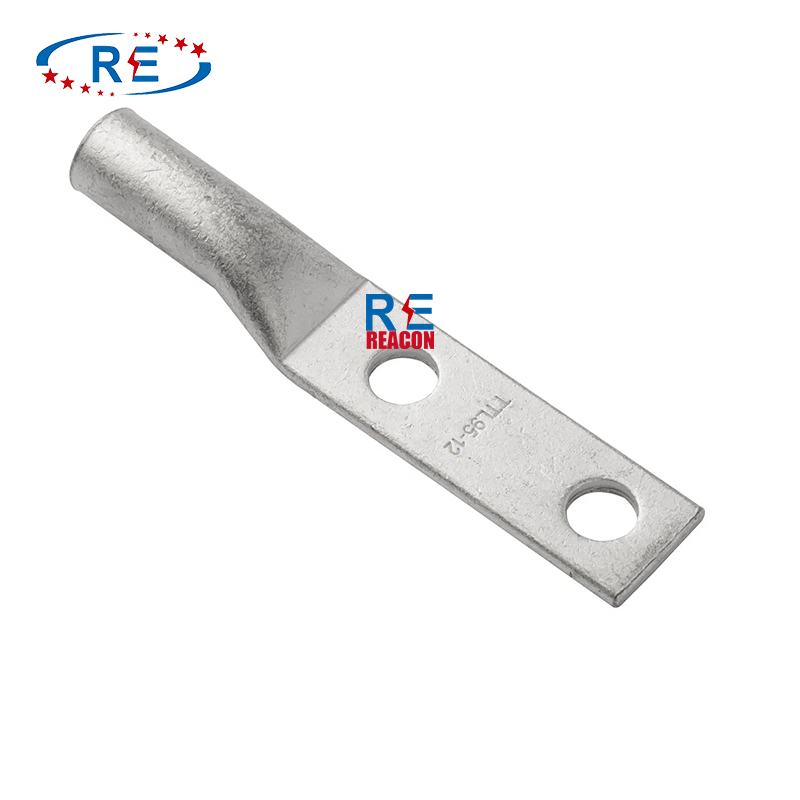
1.Connection method:Crimping is a method of instantaneously pressing the welding arm of a connector onto the surface of the connected device according to predetermined specifications through mechanical pressure, in order to achieve physical and electrical connection while removing a layer of oxide. Crimping is usually suitable for soft conductors or thin metal plates.
2.Connection strength:The crimping terminal connection is relatively simple and does not require forced instantaneous high-temperature treatment. When the connector is well crimped to the conductor, it can produce good permanence.
3.Application scope:Crimping terminals are more suitable in these application scenarios: for example, in automotive electrical and electronic equipment, as these devices require correct, safe, and stable connections between cables and accessories, permanent physical connections are crucial in this situation.

1.Fast and convenient:The connection speed of crimping terminals is fast and does not require any preprocessing.
2.High safety:Compared to welding terminals, using crimping terminal connections has higher safety because crimping can effectively reduce the risk of local heating and avoid potential threats to users.
3.High reliability: The connection of crimped terminals is highly valued, so reliability testing is usually conducted. This way, whether in high temperature, low temperature, or humid environments, the connection of crimped terminals can maintain high reliability.


1.Power Distribution Cabinets:Used to terminate incoming or outgoing cables ensuring stable current delivery.
2.Substations & Electrical Infrastructure:Installed on bus bars, transformers, disconnect switches, and switchgear.
3.Industrial Machinery Wiring:Ensures secure cable termination for large-size power wiring.
1.Strip insulation according to terminal depth.
2.Insert cable fully into the DL Aluminum Cable Lug.
3.Use a compatible hydraulic crimping tool for proper compression.
4.Apply insulation tape or heat shrink if required.
1.Manufactured to IEC, DIN, and ANSI electrical standards
2.Each batch undergoes pull-force testing and conductivity inspection
3.Oxidation-resistant treatment for long-term outdoor reliability
Q1: What is a DL aluminum cable lug used for?
A: A DL aluminum cable lug is used to terminate aluminum power cables and connect them to compatible electrical equipment, including transformers, switchgear, distribution panels, and industrial electrical systems.
Q2: What is the difference between DL aluminum lugs and CU-AL bimetal lugs?
A: DL aluminum lugs are made primarily for aluminum conductor termination. CU-AL bimetal lugs combine a copper palm and an aluminum barrel to provide a transition between compatible copper and aluminum connection interfaces.
Q3: Can aluminum cable lugs be used for overhead distribution cables?
A: Yes. Suitable DL aluminum lug configurations can be used to terminate aluminum conductors in overhead distribution systems and connect them to compatible electrical equipment.
Q4: Are DL aluminum cable lugs suitable for transformer and switchgear connections?
A: Yes. They can be used for compatible transformer terminals, switchgear assemblies, and distribution equipment. The terminal dimensions must match the equipment connection requirements.
Q5: What sizes of aluminum cable lugs are available?
A: REACON offers multiple conductor sizes. Available specifications include the published DTL10 to DTL500 dimensional range, subject to confirmation of the corresponding material and model series.
Q6: How are aluminum cable lugs installed?
A: Aluminum cable lugs are generally installed through compression crimping. A compatible crimping tool and die must be selected according to the terminal specifications.
Q7: Can REACON manufacture customized aluminum cable lugs?
A: Yes. Customized terminal dimensions, conductor ranges, and configurations can be manufactured according to customer drawings and project requirements.
Q8: What should be considered when connecting copper cables to aluminum equipment?
A: A suitable CU-AL bimetal terminal should be considered to provide a compatible material transition and reduce the risk of galvanic corrosion associated with direct copper-aluminum contact.
Q9: Are aluminum cable lugs suitable for outdoor installations?
A: Suitable configurations can be used in outdoor electrical systems. Material selection, surface condition, connection protection, and environmental requirements should be evaluated before installation.
Q10: Does REACON provide technical support for cable lug selection?
A: Yes. Customers can provide cable specifications, equipment drawings, or product samples. REACON can assist with selecting an appropriate terminal configuration.
REACON provides aluminum cable lugs and CU-AL bimetal terminals for power transmission, distribution, and industrial electrical applications. Contact us for product specifications, customized solutions, and quotations.
| Product Series | Main Material | Main Function | Typical Application |
| DL Aluminum Cable Lug | Aluminum | General aluminum cable termination | Power cables and distribution equipment |
| Transformer DL Lug | Aluminum | Equipment-side cable termination | Transformers and switchgear |
| Overhead DL Lug | Aluminum | Outdoor conductor termination | Overhead distribution networks |
| General Aluminum Terminal Lug | Aluminum | General electrical equipment connection | Distribution panels and industrial systems |
| Durable Aluminum Crimp Terminal | Aluminum | Compression-based conductor termination | Electrical panels and machinery |
| Secure-Fit Aluminum Crimp Terminal | Aluminum | Stable conductor positioning during crimping | Power distribution and control systems |
| CU-AL Bimetal Cable Lug | Copper and Aluminum | Copper-to-aluminum material transition | Transformers, busbars and substations |