WELCOME TO REACON

- All
- Product Name
- Product Keyword
- Product Model
- Product Summary
- Product Description
- Multi Field Search
 |
REACON
| Quantity: | |
|---|---|
REACON Aluminum Cable Terminals are designed for secure electrical connections between power cables and electrical equipment. Manufactured from aluminum or copper-aluminum composite materials according to the selected product series, these terminals provide practical solutions for cable termination in power distribution networks, substations, industrial facilities, and electrical infrastructure projects.
The product range includes DL aluminum cable terminals and CU-AL bimetal cable lugs. Both types are designed for compression connection, but they serve different conductor connection requirements.
DL aluminum terminals are mainly used for terminating aluminum conductors and connecting them to electrical equipment. CU-AL bimetal cable lugs are designed for transition connections between copper and aluminum conductors or equipment terminals.
With different conductor sizes and terminal configurations available, REACON supports product selection and customized manufacturing according to project requirements.
1. DL Aluminum Cable Terminal
The DL Aluminum Cable Terminal is manufactured from aluminum and designed for aluminum conductor termination.
Its lightweight construction makes installation and handling convenient, while its conductive aluminum body provides an electrical connection between the cable and the equipment terminal.
Main characteristics:
• Aluminum construction for aluminum conductor connections.
• Lightweight structure for convenient installation.
• Good electrical conductivity.
• Compression crimping connection.
• Suitable for AAC, AAAC, ACSR and compatible aluminum cables.
• Available in multiple conductor sizes.
• Suitable for indoor and outdoor electrical installations.
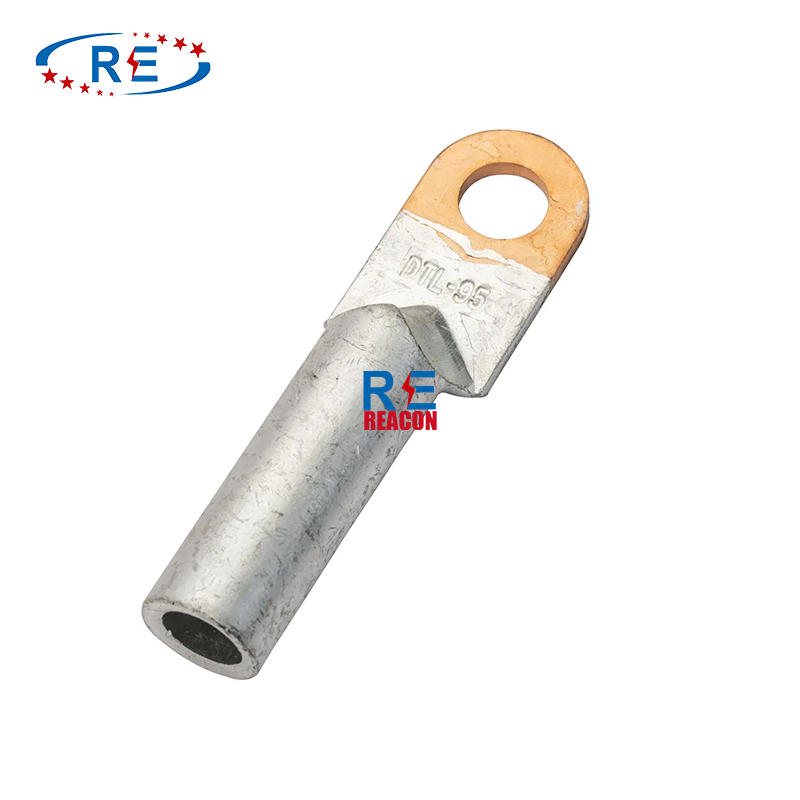
2. CU-AL Bimetal Cable Lug
The CU-AL Bimetal Cable Lug is designed for connecting copper conductors with aluminum conductors or aluminum equipment terminals.
It combines copper and aluminum components to provide a transition connection between different conductor materials. This construction helps address the compatibility challenges associated with direct copper-to-aluminum contact.
Main characteristics:
• Copper-aluminum bimetal construction.
• Designed for mixed-metal electrical connections.
• Suitable for copper-to-aluminum transitions.
• Compression installation method.
• Available in multiple conductor cross-sections.
• Suitable for transformers, substations and distribution equipment.
The DL aluminum terminal and CU-AL bimetal lug should be selected according to conductor material and equipment connection requirements. They are not interchangeable products.

Reliable Electrical Conductivity
The aluminum terminal body provides an electrical path for compatible aluminum conductors. The CU-AL bimetal design provides a transition connection between copper and aluminum components.
Correct product selection and installation help maintain stable electrical contact.
Lightweight and Practical Construction
Aluminum terminals are lightweight compared with many copper terminal alternatives, making transportation, handling and installation more convenient.
Corrosion Resistance
Aluminum construction offers practical corrosion resistance for electrical installations. For outdoor and demanding environments, the terminal material, surface condition and installation requirements should be considered together.
Secure Compression Connection
The terminals are installed using suitable compression tools and dies. Correct crimping helps create a firm mechanical connection and reduces the possibility of conductor loosening.
Multiple Conductor Sizes
Different cable cross-sections are available to meet the connection requirements of distribution networks, electrical equipment and industrial installations.
REACON aluminum cable terminals and CU-AL bimetal cable lugs are used in various electrical connection applications.
1. Power Distribution Networks
Used for terminating aluminum power cables and connecting conductors to distribution equipment.
2. Transformer Connections
Applied at transformer cable connection points where suitable aluminum or copper-aluminum terminal configurations are required.
3. Switchgear and Distribution Cabinets
Used to connect incoming and outgoing power cables to compatible electrical terminals and equipment interfaces.
4. Substations
Suitable for cable termination in substation electrical installations, subject to the required conductor and equipment specifications.
5. Industrial Electrical Systems
Used in industrial control panels, power distribution assemblies and electrical machinery connections.
6. Renewable Energy Installations
Can be applied in solar and wind power electrical systems where compatible cable termination components are required.

Correct installation is important for maintaining electrical continuity and mechanical connection strength.
1. Select the terminal according to the conductor material and cable cross-section.
2. Strip the cable insulation to the required insertion length without damaging the conductor strands.
3. Clean the conductor surface according to the applicable installation procedure.
4. Insert the conductor fully into the terminal barrel.
5. Select a compatible hydraulic crimping tool and die size.
6. Complete the compression operation according to the terminal manufacturer’s crimping requirements.
7. Inspect the crimped connection and verify that the conductor is securely held.
8. Connect the terminal palm to the electrical equipment using suitable bolts and fasteners.
9. Apply appropriate insulation or protective treatment when required by the installation design.
For CU-AL bimetal terminals, confirm that the copper and aluminum connection sides are correctly matched before installation.
| Item | DL Aluminum Cable Terminal | CU-AL Bimetal Cable Lug |
| Product Type | Aluminum Cable Terminal | Bimetal Cable Lug |
| Main Material | Aluminum | Copper and Aluminum |
| Connection Function | Aluminum Cable Termination | Copper-Aluminum Transition |
| Installation Method | Compression Crimping | Compression Crimping |
| Conductor Compatibility | Compatible Aluminum Conductors | Copper and Aluminum Connection |
| Typical Applications | Distribution Equipment, Transformers, Switchgea | Transformers, Substations, Mixed-Metal Connections |
| Service Environment | Indoor / Outdoor | Indoor / Outdoor |
| Customization | Available | Available |
The following table presents the DTL series dimensions listed for the CU-AL bimetal cable lug range.
| Item No. | Cable Specification (mm²) | Ø (mm) | D (mm) | d (mm) | L (mm) | L1 (mm) | B (mm) |
| DTL10 | 10 | 8.5 | 10 | 6 | 68 | 28 | 16 |
| DTL16 | 16 | 8.5 | 11 | 6 | 70 | 32 | 16 |
| DTL25 | 25 | 8.5 | 12 | 7 | 75 | 34 | 18 |
| DTL35 | 35 | 10.5 | 14 | 8.5 | 85 | 40 | 20.5 |
| DTL50 | 50 | 10.5 | 16 | 9.8 | 90 | 42 | 23 |
| DTL70 | 70 | 12.5 | 18 | 11.5 | 100 | 47 | 26 |
| DTL95 | 95 | 12.5 | 21 | 13.5 | 110 | 50 | 28 |
| DTL120 | 120 | 14.5 | 23 | 15 | 120 | 53 | 30 |
| DTL150 | 150 | 14.5 | 25 | 16.5 | 125 | 55 | 34 |
| DTL185 | 185 | 17 | 28 | 18.5 | 136 | 58 | 37 |
| DTL1240 | 240 | 17 | 30 | 21 | 148 | 60 | 40 |
| DTL300 | 300 | 21 | 34 | 23.5 | 165 | 65 | 50 |
| DTL400 | 400 | 21 | 38 | 27 | 170 | 70 | 50 |
Additional listed model: DTL500
The original product page also lists DTL500 with a cable specification of 500D and dimensions of Ø21 mm, D47 mm, d29 mm, L225 mm, L1 75 mm and B60 mm.
Please confirm whether the cable specification should be 500 mm² before publishing this model as a standard specification.
Dimension Reference:
• Ø: Mounting hole diameter
• D: Outer diameter
• d: Inner diameter
• L: Overall length
• L1: Barrel length
• B: Terminal palm width
The DTL dimensions above apply to the CU-AL bimetal cable lug series. They should not be automatically treated as dimensional specifications for the DL aluminum terminal series.
REACON focuses on material consistency, dimensional accuracy and connection performance during terminal manufacturing.
Quality inspection may include:
• Raw material inspection.
• Dimensional measurement.
• Electrical conductivity inspection.
• Mechanical strength evaluation.
• Surface condition inspection.
• Compression connection verification.
Specific inspection requirements and applicable standards can be confirmed according to the customer’s technical specifications and project requirements.
Choosing the correct cable terminal depends on several factors:
1. Conductor Material
Select a DL aluminum terminal for compatible aluminum conductor termination. Select a CU-AL bimetal terminal when a copper-to-aluminum transition connection is required.
2. Cable Cross-Section
Choose the terminal model according to the actual conductor cross-section. The terminal barrel must match the cable size.
3. Equipment Connection
Confirm the mounting hole diameter, terminal palm dimensions and bolt requirements before ordering.
4. Installation Method
Check the required crimping tool, die size and compression procedure for the selected terminal.
5. Operating Environment
Consider outdoor exposure, humidity, corrosion conditions and any additional protective measures required by the project.
Q1: What is the difference between a DL aluminum terminal and a CU-AL bimetal cable lug?
A: A DL aluminum terminal is designed for aluminum conductor termination. A CU-AL bimetal cable lug is designed to provide a transition connection between copper and aluminum components.
Q2: Which cable types can be used with aluminum cable terminals?
A: Compatible aluminum conductors may include AAC, AAAC, ACSR and other aluminum power cables. The terminal must be selected according to the conductor construction and cross-section.
Q3: What does the DTL model number represent?
A: DTL model designations identify the bimetal cable lug product series and corresponding conductor size. For example, DTL120 is listed for a 120 mm² cable specification.
Q4: How are aluminum cable terminals installed?
A: They are generally installed by compression crimping using a compatible hydraulic crimping tool and die.
Q5: Can CU-AL bimetal cable lugs connect copper and aluminum conductors?
A: Yes. They are designed for copper-aluminum transition connections. Correct orientation and installation are important.
Q6: Are these cable terminals suitable for outdoor applications?
A: They can be used in suitable outdoor electrical installations. The material, surface condition and environmental requirements should be checked for each project.
Q7: Does REACON provide customized cable terminal sizes?
A: Yes. REACON can discuss customized dimensions, conductor ranges and product configurations according to technical drawings and project requirements.
Q8: What information should be provided when requesting a quotation?
A: Please provide the terminal type, conductor material, cable cross-section, mounting hole size, required quantity and any available drawings or technical specifications.
REACON supplies cable terminals and electrical connection accessories for power distribution, utility infrastructure and industrial electrical projects.
We support product selection and customized manufacturing according to conductor specifications, equipment connection requirements and technical drawings.
Contact REACON for product details, model confirmation and quotations.


